
This programme invites participants into that deeper understanding—where dowsing becomes a practice of clarity, neutrality, and responsibility, rather than prediction or power.

Dowsing is often misunderstood.
To some, it appears mystical or unpredictable. To others, it is dismissed as superstition. In truth, authentic dowsing exists in a far quieter and more grounded space—one that lies at the intersection of awareness, intention, and the body’s innate responsiveness.
This course approaches dowsing not as a belief system, but as a discipline of perception.
Across ancient cultures, dowsing was used to locate water, assess land, understand energetic conditions, and support decision-making. In modern contexts, when stripped of exaggeration and fear-based narratives, dowsing emerges as a refined method of listening to subtle information through regulated awareness.
This programme invites participants into that deeper understanding—where dowsing becomes a practice of clarity, neutrality, and responsibility, rather than prediction or power.

At its core, this dowsing course is built on three foundational principles:
Dowsing does not function optimally through desire, urgency, or emotional charge. It responds best to stillness, grounded presence, and clear intention. Therefore, this course does not rush students into advanced applications. Instead, it builds the inner conditions required for reliable practice
The aim is not to teach people to “get answers,” but to help them develop the capacity to listen without distortion.
Historically, dowsing appears across civilizations:
While the tools differed, the underlying mechanism remained consistent: the body acting as a responsive instrument when the mind is clear and neutral.

Modern psychology and neuroscience now offer complementary insights. Research into the subconscious, ideomotor response, and embodied cognition suggests that the human system processes vast amounts of information beneath conscious awareness. Dowsing, when practiced responsibly, operates through this subtle interface between awareness and bodily response.
This course bridges these ancient and modern perspectives—without reducing dowsing to either mysticism or mechanistic explanation.

This programme is designed to support both spiritual enrichment and practical mastery, without privileging one over the other.
Participants will explore:
The course respects the intelligence of the learner and avoids sensationalism.
Rather than presenting dowsing as something external or magical, this course begins by exploring how dowsing responses arise internally.
Key areas of understanding include:
Participants learn that dowsing accuracy is directly related to inner state, not external force.
Grounding, Centering, and NeutralityOne of the most critical components of effective dowsing is grounding. Without grounding, responses become erratic, emotionally influenced, or biased.
This course teaches:
Grounding is taught not as a ritual, but as a physiological and psychological skill.
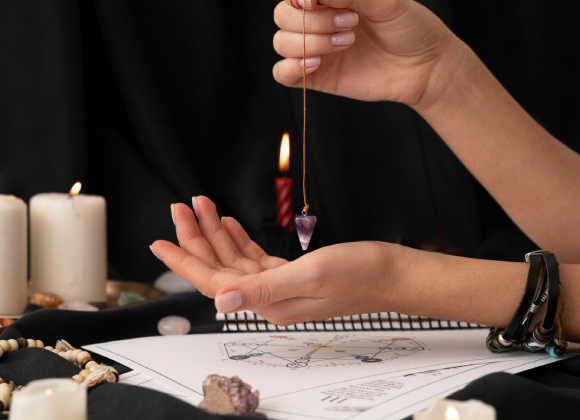
Tools such as pendulums and rods are not sources of information; they are amplifiers of subtle response.
Participants are guided through:
The emphasis remains on awareness through the body, not reliance on objects.
Calibration and AccuracyCalibration is the process of establishing clear response patterns—most commonly “yes,” “no,” and “neutral.”
This course covers:
Accuracy is framed as a practice, not a guarantee.
In dowsing, the quality of the response is inseparable from the quality of the question.
Participants learn:
This section is central to developing ethical and reliable practice.
Limits of DowsingEqually important is understanding where dowsing should not be used.
The course clearly outlines:
This protects both the practitioner and those they support.
Dowsing carries influence. Even when used gently, it can affect perception and decision-making. Therefore, ethics are woven throughout the course, not confined to a single module.
Key ethical considerations include:
Students are taught that not dowsing is sometimes the most responsible choice.
Emotional and Psychological SafetyThe course is designed to be trauma-aware and emotionally safe. It avoids practices that create fear, dependency, or identity inflation.
Participants learn to:
At a foundational level, dowsing supports:
Used this way, dowsing becomes a tool for self-responsibility, not avoidance.
Integration with Wellness PracticesFor practitioners (Reiki, healing, coaching), the course explores how dowsing may be used:
Clear boundaries are maintained to prevent misuse.
True mastery in dowsing does not come from speed or complexity. It develops through:
The course encourages students to move slowly and consciously.
From Curiosity to CompetenceBy the end of this programme, participants will not only know how to dowse, but:
This discernment is the hallmark of ethical mastery.
This course is:
Students are supported to develop confidence without arrogance and sensitivity without overwhelm.
This training is suitable for:
It is not designed for sensationalism or quick results.
At its deepest level, dowsing is not about finding answers—it is about learning how to listen.
Listening to the body.Listening to subtle response.Listening to the moment when clarity is present—and when it is not.
This course invites participants into that listening.
Not to escape uncertainty, but to meet it with awareness, humility, and grounded presence.
